What Happens If You Wear Loose Dentures Too Long? Spokane Denture Fit Guide
- Aug 20
- 9 min read

Loose dentures may seem like a small inconvenience at first, but wearing them too long can lead to bigger problems. A denture that slips, rocks, clicks, or rubs can irritate the gums, reduce chewing strength, affect speech, increase adhesive use, and place uneven pressure on the jaw.
At Grishin Denture Specialist, we help patients searching for dentures Spokane, dentures Spokane WA, Spokane dentures, dentures in Spokane, and dentures near me understand why looseness should be addressed early. A denture should feel stable, balanced, and comfortable—not something you have to fight with every day.
Why Do Dentures Become Loose?
Dentures become loose because the gums and jawbone naturally change shape after tooth loss.
After teeth are removed, the jawbone gradually remodels and the gum ridge becomes smaller, flatter, or less supportive. This is a normal biological process, but it can change how the denture sits. A denture that once fit well may no longer match the mouth closely years later—or sometimes even months after extractions.
Loose dentures can also happen because of:
Gum and bone shrinkage
Worn denture teeth
Poor bite balance
Weight changes
Dry mouth
Worn acrylic surfaces
Weak suction
Older dentures that no longer fit the current gum shape
Dentures that need an adjustment, reline, or replacement
For patients searching for a denture clinic near me, looseness is one of the most important warning signs to check early. The sooner the cause is identified, the easier it may be to restore comfort.
What Happens If You Keep Wearing Loose Dentures?
If you keep wearing loose dentures, they can rub the gums, reduce chewing ability, affect speech, increase adhesive dependence, and create uneven bite pressure.
A loose denture does not stay seated properly. Instead, it shifts during chewing, speaking, swallowing, and laughing. That movement can create friction against the gums and instability in the bite.
Over time, loose dentures may lead to:
Sore gums
Red or irritated tissue
Food trapping under the denture
Clicking during speech or chewing
Reduced chewing confidence
More adhesive use
Uneven pressure on the ridge
Speech hesitation
A less secure smile
Frustration during meals
Loose dentures should not be ignored, especially if the fit is getting worse or adhesive is becoming part of your daily routine.
Can Loose Dentures Cause Sore Gums?
Yes. Loose dentures can rub the gums and create painful sore spots.
When a denture moves back and forth, the acrylic base can rub against the tissue. The gums are designed to tolerate gentle, even pressure, but they do not tolerate repeated friction well. Over time, rubbing can lead to redness, tenderness, swelling, and ulcer-like sores.
A sore spot may start small, but repeated pressure can make it difficult to wear the denture comfortably. Patients may begin removing the denture more often, avoiding certain foods, or chewing only on one side.
If gum soreness keeps returning, the denture should be evaluated. The problem may be caused by looseness, bite imbalance, overextended borders, gum shrinkage, or a denture that no longer fits properly.
For more detail on pressure-related soreness, read Hidden Bite Forces: How Uneven Pressure Damages Your Gums and Dentures Over Time.
Can Loose Dentures Affect Chewing?
Yes. Loose dentures can make chewing weaker, slower, and less predictable.
When dentures shift during meals, patients often stop trusting them. Instead of chewing confidently, they may avoid firmer foods, chew only on one side, or choose softer foods because they feel safer. Over time, this can reduce diet variety and make eating feel stressful.
Loose dentures may cause chewing problems such as:
Dentures lifting while biting
Food collecting underneath
Difficulty chewing meats or crunchy foods
Avoiding fruits, vegetables, or textured foods
Chewing mostly on one side
Sore gums after meals
Reduced confidence eating in public
Many patients begin eating softer foods not because they prefer them, but because their dentures no longer feel dependable. If eating feels stressful, our guide Progressing From Soft to Crunchy: A Guide to Reintroducing Texture With Dentures explains how comfort, stability, and gradual food progression work together.
Can Loose Dentures Change Your Bite?
Yes. Loose dentures can make the bite feel uneven because the denture shifts before the teeth come together.
When the upper and lower denture teeth do not meet evenly, the denture may rock, tip, or press harder into one area of the gums. This can create soreness and instability even if the denture does not appear damaged.
An uneven bite may cause:
Clicking during chewing
Sore spots on one side
Dentures tipping during meals
Jaw muscle tension
Difficulty chewing evenly
Gum tenderness after eating
A feeling that one side hits first
Over time, patients may unconsciously change how they chew to keep the denture stable. This can place more stress on certain areas of the mouth and make the denture feel even less natural.
A quality Spokane denture clinic should evaluate both the fit of the denture base and the way the upper and lower teeth contact.
Does Adhesive Fix Loose Dentures?
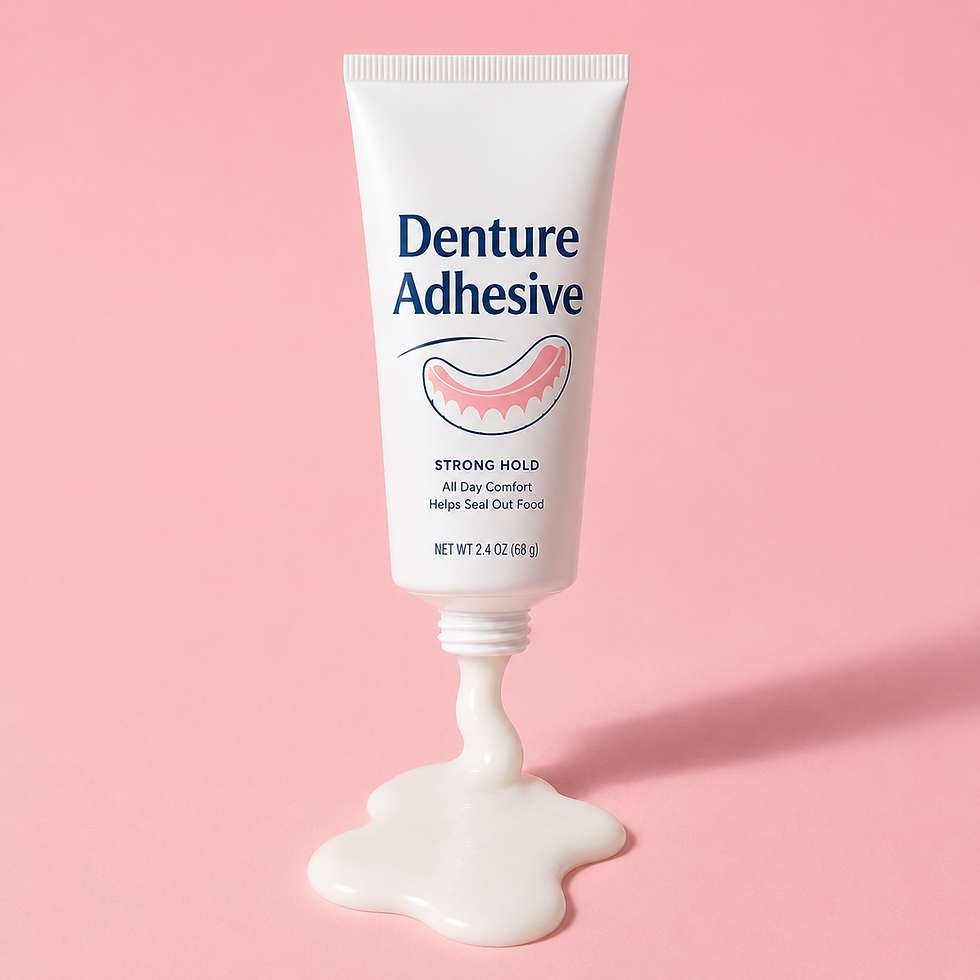
Denture adhesive may help temporarily, but it does not fix the cause of loose dentures.
If a denture no longer fits the gums closely, adhesive may fill space for a short time. However, it does not restore the original fit, correct gum shrinkage, balance the bite, or improve the denture base. Heavy adhesive use can also trap residue and bacteria against the tissue.
Adhesive may become a concern when:
You need more than before
You reapply it several times per day
Dentures still move even with adhesive
Residue is thick or difficult to clean
Food collects under the denture
Gums feel irritated
Chewing still feels unstable
If adhesive residue is becoming difficult to remove, read Denture Adhesive Residue: When Is Too Much Adhesive a Problem?.
Patients searching for affordable dentures Spokane or Affordable Dentures Spokane should remember that adhesive is not a replacement for proper fit. A professionally evaluated denture may need an adjustment, reline, or replacement instead of more adhesive.
Can Loose Dentures Affect Speech?
Yes. Loose dentures can affect speech because they may move while the tongue, lips, and cheeks are trying to form words.
Speech depends on stable contact between the tongue, teeth, lips, and palate. When dentures shift, patients may notice clicking, mumbling, lisping, whistling, or hesitation during conversation. Even when the denture does not fall out, the fear of movement can make speaking feel less natural.
Loose dentures may affect speech by causing:
Clicking sounds
Slurred words
Lisping
Trouble with “S,” “F,” “V,” or “Th” sounds
Hesitation before speaking
Reduced confidence in public conversation
A feeling that the denture may slip
Speech confidence is closely tied to denture stability. If patients worry that their dentures may move while talking, they often speak less freely.
Can Loose Dentures Cause More Food Trapping?
Yes. Loose dentures can allow more food to collect underneath because the denture no longer seals closely against the gums.
When the denture lifts or rocks during eating, small food particles can slip under the base. This can cause irritation, bad taste, sore gums, and frustration during meals.
Food trapping may be a sign of:
Poor suction
Gum shrinkage
Denture movement
Border seal problems
Bite imbalance
A denture that needs a reline
A denture that no longer fits the ridge
A properly fitting denture should not constantly trap food during normal meals. If this becomes a daily problem, it is time for a denture evaluation.
Can Loose Dentures Affect Facial Support?
Yes. Loose dentures can affect facial support if they no longer sit in the correct position.
Dentures help support the lips, cheeks, and lower face. When a denture becomes loose or shifts out of position, the face may not be supported the same way. Patients may notice changes in their smile, lip support, or the way the denture feels when speaking.
Loose dentures may make the face feel or appear:
Less supported
More sunken around the mouth
Uneven during smiling
Less stable when speaking
Different than when the dentures were new
For patients comparing denture clinics Spokane WA, this is why fit evaluation should include more than sore spots. Dentures affect function, facial support, speech, and confidence.
Can Loose Dentures Cause Bone Loss?
Loose dentures do not directly stop or start the natural bone resorption that happens after tooth loss. However, chronic movement and uneven pressure can irritate the tissues that support the denture.
After tooth loss, bone changes are expected over time. As the ridge changes, dentures may become looser. When loose dentures continue to move, they can create more irritation, instability, and uneven pressure on the tissues.
Regular checks with a denturist Spokane can help monitor these changes and determine whether a reline, adjustment, or new denture is needed.
How Does Poor Suction Make Dentures Looser?
Poor suction makes dentures looser because the denture base is no longer sealing closely against the oral tissues.
A well-fitting upper denture often relies on close adaptation between the denture base, saliva, and soft tissue. When the denture does not match the gums closely, suction weakens. The denture may then drop, shift, or require more adhesive.
Poor suction may be caused by:
Gum shrinkage
Dry mouth
Poor border seal
Worn denture base
Overextended or underextended borders
Uneven bite pressure
Food trapped under the denture
Dentures that need a reline
For a deeper explanation, read How Denture Suction Really Works — The Hidden Physics Behind a Secure, Comfortable Fit.
When Should Loose Dentures Be Checked?
Loose dentures should be checked when they slip during speaking, rock during chewing, trap food, cause soreness, or require more adhesive than before.
You should schedule a denture visit if you notice:
Dentures slipping while talking
Dentures rocking while chewing
Food getting trapped underneath
Clicking sounds
Sore gums
Red or irritated tissue
More adhesive use
Weaker suction
Difficulty chewing firm foods
Dentures that feel different than before
A professional evaluation can determine whether the denture needs an adjustment, reline, repair, bite correction, or replacement.
What Are the Treatment Options for Loose Dentures?
The right treatment depends on why the denture is loose.
Possible solutions include:
Adjustment: Helps relieve pressure spots or correct minor irritation.
Reline: Reshapes the tissue side of the denture so it fits the gums more closely.
Bite correction: Balances chewing pressure so the denture does not rock or tip.
Professional cleaning and polishing: Removes buildup and smooths rough areas.
Denture repair: Helps when cracks or damage affect stability.
New denture fabrication: May be needed when the denture is worn, unstable, or no longer fits properly.
Implant-supported options: May be considered when appropriate for patients who need additional retention.
A proper diagnosis matters. The same symptom—looseness—can have different causes.
Why Accurate Denture Fit Starts With Careful Impressions
A stable denture starts with accurate impressions and careful control of the soft-tissue details.
At Grishin Denture Specialist, we use traditional alginate impressions because they allow us to capture soft-tissue shape with careful control. We have tested digital and 3D-printed methods, but our experience has shown that traditional techniques provide better control, accuracy, and definition for many denture cases.
This matters because a denture must match the gums, borders, and tissue shape closely. When the foundation is accurate, the denture is more likely to seat properly, maintain suction, and distribute pressure evenly.
A precise denture foundation can help support:
Better suction
More stable chewing
Fewer sore spots
Better speech confidence
Less food trapping
Improved comfort
More natural facial support
Reduced adhesive dependence
For more on precision fit, read The Science of a Perfect Denture Fit.
FAQ: Wearing Loose Dentures Too Long
What happens if I keep wearing loose dentures?
Wearing loose dentures too long can lead to sore gums, food trapping, weaker chewing, speech changes, increased adhesive use, and uneven bite pressure.
Why do dentures become loose over time?
Dentures become loose because the gums and jawbone change shape after tooth loss. Worn denture teeth, dry mouth, weight changes, and poor bite balance can also contribute.
Can loose dentures cause sore spots?
Yes. Loose dentures can slide against the gums and create friction, redness, tenderness, and sore spots.
Will more adhesive fix loose dentures?
No. Adhesive may help temporarily, but it does not correct gum shrinkage, poor suction, bite imbalance, or an old denture that no longer fits.
Can loose dentures make chewing harder?
Yes. Loose dentures can shift during meals, making chewing weaker and less predictable. Patients may avoid firmer foods or chew only on one side.
Can a reline help loose dentures?
Yes. A reline may help if the denture is loose because the gums have changed shape but the denture is otherwise in good condition.
When should I see a denturist for loose dentures?
You should schedule a visit if your dentures slip, rock, trap food, cause soreness, click, or require more adhesive than before.
Conclusion

Wearing loose dentures too long can lead to sore gums, reduced chewing confidence, speech changes, increased adhesive use, food trapping, and uneven bite pressure. The longer the denture moves, the more frustrating daily life can become. A loose denture should be checked before soreness, instability, or adhesive dependence becomes a bigger problem.
At Grishin Denture Specialist, we help patients across Spokane, Spokane Valley, Cheney, Deer Park, Liberty Lake, and surrounding communities restore comfort with precise adjustments, relines, professional cleanings, and high-quality new dentures when needed. Denturist Michael Grishin evaluates the cause of looseness so the solution is based on fit, suction, bite balance, and tissue health—not guesswork.
If you are searching for dentures Spokane, dentures Spokane WA, Spokane dentures, dentures in Spokane, dentures near me, denture clinic near me, denture clinics Spokane WA, affordable dentures Spokane, denturist Spokane, or a trusted Spokane denture clinic, visit Grishin Denture Specialist to have loose dentures professionally evaluated for better comfort, stability, and confidence.
If your dentures require more adhesive to stay secure, learn why proper denture fit may be a better solution in our guide on how dentures can fit better without more adhesive.
Stay Connected!
Instagram: @grishindentures
Facebook: GrishinDentureSpecialist
Twitter/X: @grishindentures